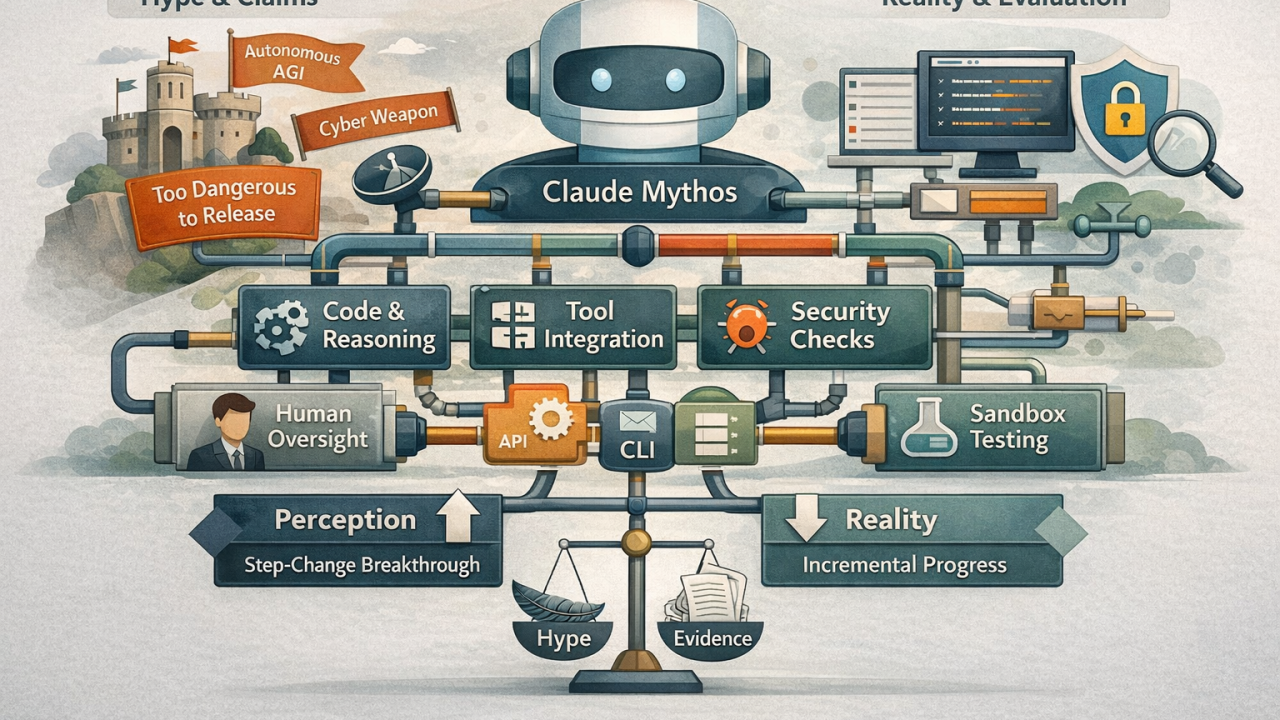
Claude Mythos: An Industry-Grade Reality Check
Capability vs perception in the Claude Mythos narrative.
There’s a growing narrative around Anthropic’s Claude Mythos that positions it as a breakthrough—borderline mythical in capability. But when you step back and evaluate it through an engineering, enterprise, and systems lens, a more grounded picture emerges.
This isn’t a story about fake versus real. It’s a story about capability versus perception.
Executive Summary
Claude Mythos likely represents real, incremental progress at the frontier—particularly in reasoning, coding, and tool interaction. However:
- Claims around autonomy and cyber capabilities are overstated or insufficiently evidenced.
- "Too dangerous to release" is part safety consideration and part strategic positioning.
- Enterprise adoption is often misunderstood—what exists today is controlled evaluation, not trust or dependency.
The real gap is this:
What the model can do versus how it is being framed.
1. Claims vs Reality
Public positioning around Mythos includes:
- "Step-change capability"
- "Too powerful for broad release"
- Advanced autonomy (e.g., vulnerability discovery)
But when mapped against available evidence:
| Claim | Assessment | | --------------------------------- | ---------------------------- | | Coding and reasoning improvements | Credible | | Tool-use and agent workflows | Real, but scaffold-dependent | | Autonomous cyber capability | Unproven | | "Too dangerous to release" | Non-reproducible claim |
This is not unusual. It follows a broader pattern that has emerged across the AI industry.
2. Where Progress Is Real
Let's be clear: this is not vaporware.
There are meaningful advancements:
Structured Reasoning
Better decomposition of complex tasks and more consistent multi-step execution.
Code Intelligence
Improved multi-file reasoning, refactoring, and debugging capabilities.
Tool-Oriented Execution
More effective interaction with APIs, CLI tools, and structured outputs.
These improvements matter. However, they are evolutionary advances, not exponential leaps.
3. Where the Narrative Breaks
This is where hype begins to diverge from reality.
The system still depends heavily on:
- Prompt design
- Tool orchestration
- Human supervision
It is not operating independently in real-world environments.
Cybersecurity Claims
AI systems can assist with:
- Pattern detection
- Known vulnerability identification
- Security analysis acceleration
However, they cannot:
- Reliably discover novel zero-day vulnerabilities at scale
- Execute end-to-end attack chains autonomously
- Operate as fully independent offensive cyber systems
At best, these models function as accelerators—not attackers.
The General Intelligence Narrative
The model remains constrained by:
- Context limitations
- Hallucinations
- Lack of persistent reasoning architectures
These limitations continue to create boundaries around autonomous performance.
4. "Too Dangerous to Release" — What It Really Means
This statement receives significant attention, but it deserves careful interpretation.
It likely reflects a combination of:
- Legitimate safety concerns
- Strategic positioning within the AI race
- Operational limitations around cost, scale, and alignment maturity
A more accurate interpretation might be:
Not ready for unrestricted deployment under current control mechanisms.
That statement is considerably different from claims suggesting the model possesses extraordinary autonomous capabilities.
5. The Big Tech Myth
A major narrative driver is the claim that Anthropic shared Mythos with organizations such as AWS, Apple, JPMorgan, and others to identify vulnerabilities and gather feedback.
The idea that these companies are actively "using" or "trusting" such models is often misunderstood.
What is actually happening in most cases:
- Controlled sandbox evaluations
- Strict data isolation
- Limited and scoped use cases
- Zero-trust integration patterns
No serious enterprise is exposing core systems, critical infrastructure, or proprietary codebases to third-party models without extensive controls and governance mechanisms.
Adoption does not equal trust.
It means:
Evaluation under constraints.
6. Performance Reality
Across frontier models—not just Mythos—we are observing:
- Improvements in structured tasks and benchmark performance
- Regressions in consistency, latency, and operational cost
Progress remains non-linear.
Gains in one dimension frequently introduce trade-offs in another.
This is a characteristic of current-generation AI systems rather than evidence of a singular breakthrough.
7. Structural Issues in Evaluation
Three systemic problems continue to shape public perception.
Benchmark Limitations
Benchmarks are optimized for controlled tasks rather than real-world complexity.
Selective Disclosure
Best-case scenarios are highlighted, while failure cases receive significantly less attention.
Reproducibility Gap
Independent validation remains limited.
The result is a widening gap between:
Measured capability versus marketed capability.
8. What Mythos Actually Is
What It Is
A highly capable next-generation model with strengths in:
- Coding
- Reasoning
- Tool orchestration
What It Is Not
- Autonomous AGI
- A cyber weapon
- Fully aligned
- Independently validated at the levels often claimed publicly
Final Verdict
Capability
Real progress, but not a discontinuous leap.
Risk
Some legitimate concerns, but amplified through narrative.
Enterprise Adoption
Real, but controlled—not endorsement and not dependency.
Closing Thought
Claude Mythos is not a myth.
But the myth surrounding Mythos absolutely exists.
And right now, in frontier AI:
Narrative is scaling faster than verified understanding.