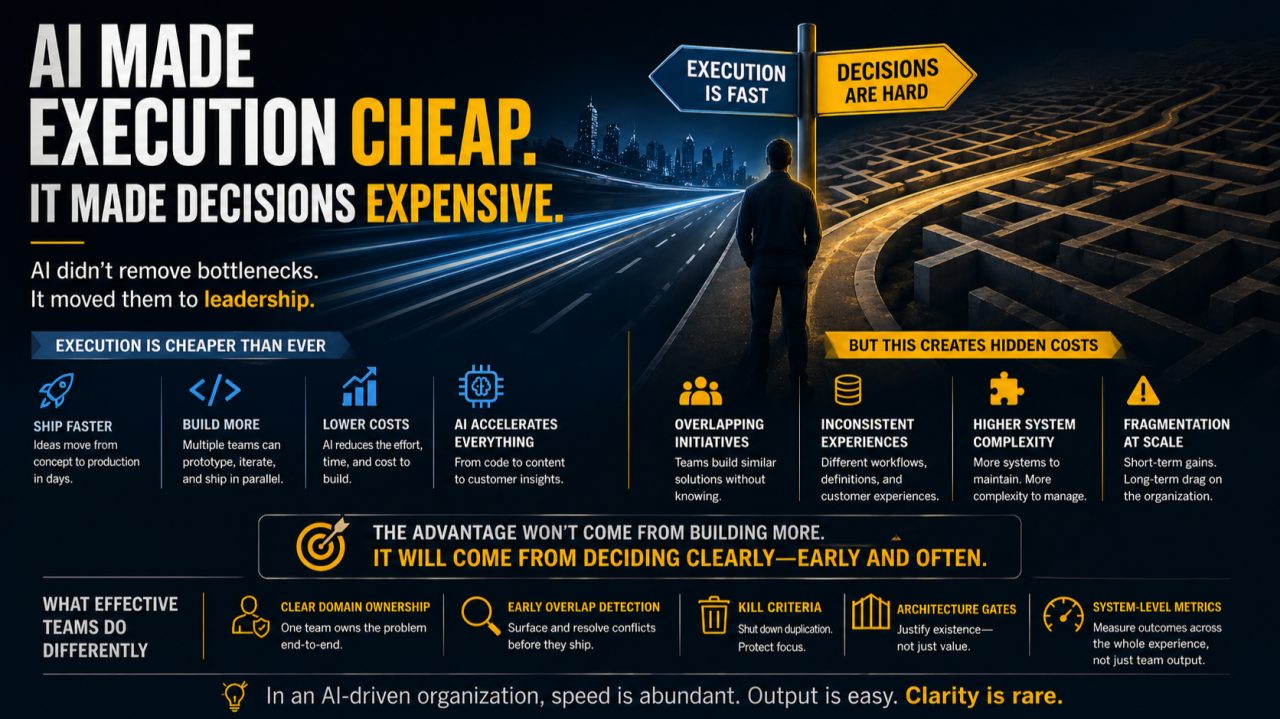
The New Bottleneck in AI-Driven Organizations Isn't Code — It's Decisions
As AI accelerates execution, decision-making becomes the new organizational constraint.
In a previous article, we looked at the first trap AI creates:
We can write code faster than we can understand it.
Let's assume you've solved that.
Your team slows down just enough. Pull requests are reviewed properly. Systems remain clean and maintainable.
No chaos. No obvious dysfunction.
On paper, everything looks healthy.
And yet...
Something still feels off.
A Familiar Scene (Now Accelerated)
A product leader walks into a quarterly review.
The dashboard looks excellent:
- More features shipped than last quarter
- Cycle time is down
- AI adoption is up
- Cost per ticket is lower
Everything signals progress.
Then the questions begin:
- Why are customers still confused?
- Why are teams building similar features?
- Why does every workflow feel slightly different?
- Why are we reworking things we just shipped?
There’s no clear answer.
Because the problem isn't visible in the metrics.
We've Seen This Before — Just Slower
This pattern isn't new.
In large-scale platform organizations operating with autonomous teams, local optimization has always created overlap, fragmentation, and inconsistent user experiences.
But there was a natural constraint:
Execution was expensive.
Time, effort, and coordination acted as filters.
Not everything could be built.
Bad decisions had limits.
AI Removes That Filter
Now that filter is weaker.
The initial act of building has become dramatically cheaper.
Multiple teams can:
- Explore the same idea
- Prototype in parallel
- Ship in days
What once acted as a natural gate—cost, time, and effort—is no longer doing its job.
Ideas that would have been rejected earlier now make it into production.
Not because they are better.
Because they are easier to build.
And That's the Problem
When the cost of building drops, the discipline of prioritization often drops with it.
Resource constraints fade.
Justification becomes lighter.
Sequencing becomes optional.
So instead of choosing carefully—
Teams build freely.
What This Looks Like in Practice
Take a typical enterprise platform.
Six Months Ago
- One reporting system
- One workflow
- Clear ownership
Today
- One team builds a dashboard generator
- Another adds an AI-powered summary layer
- A third creates a custom reporting workflow
Each solution is useful.
Each ships quickly.
None are aligned.
The result:
- Multiple reporting experiences for customers
- Conflicting data definitions
- Overlapping systems to maintain
- Increasing coordination overhead
From the outside:
Innovation.
From the inside:
Fragmentation.
And while building felt cheap, maintaining all of this is not.
Fixing Code Didn't Fix This
Even with:
- Clean code
- Strong reviews
- Good engineering discipline
You still end up here.
Because the issue isn't how things are built.
It's why they're built.
When Execution Speeds Up, Decision Cost Explodes
This is the shift most organizations haven't fully internalized.
Before
- Execution was the bottleneck
- Decisions were naturally constrained
Now
- Execution is fast
- The system cost of decisions is delayed
And delayed costs are dangerous.
Because by the time they show up—
They're embedded across teams, systems, and workflows.
Unconstrained decisions don't create freedom.
They create noise.
The Metrics Still Look Great
That's what makes this dangerous.
Dashboards continue to show:
- Velocity ↑
- Throughput ↑
- Cost per task ↓
Because these are easy to measure.
They fit reporting cycles.
They map cleanly to team-level performance.
But they miss what actually matters:
- Redundant work across teams
- Misaligned priorities
- System-level inconsistency
So leadership pushes for more:
- More output
- More speed
- More AI adoption
Without realizing they're scaling fragmentation.
The Bottleneck Has Moved
AI didn't eliminate constraints.
It relocated them.
From engineering → to leadership.
Because now the hard problems are:
- Saying no when everything is possible
- Defining clear ownership boundaries
- Maintaining coherence across fast-moving teams
Most organizations aren't built for this.
They're designed to scale execution—not judgment.
And most incentives still reward:
- Shipping more
- Moving faster
- Showing visible progress
Not maintaining system coherence.
So optimization becomes local.
And fragmentation becomes inevitable.
What Effective Teams Are Doing Differently
The best teams aren't slowing AI down.
They're tightening decision-making.
Not through intent.
Through structure.
They introduce mechanisms such as:
Clear Domain Ownership
One team owns a problem space end-to-end.
Early Overlap Detection
Competing initiatives are surfaced and resolved before they ship.
Kill Criteria
Projects are actively shut down when duplication appears.
Architecture Gates
New systems must justify their existence—not just their value.
System-Level Metrics
Success is measured across the customer experience, not per team.
In other words:
They reintroduce friction—intentionally.
The Real Shift
You fixed low-quality code.
That was the first problem.
The deeper one remains:
Execution is no longer the bottleneck. Decision-making is.
The Question That Matters Now
If your team can build almost anything—
How do you decide what's worth building?
Because in an AI-driven organization:
- Speed is abundant
- Output is easy
But clarity is rare.
Closing Thought
AI didn't make organizations smarter.
It made them faster.
And speed without direction doesn't create advantage—
It amplifies mistakes.
In a world where almost anything can be built, competitive advantage doesn't come from building more.
It comes from deciding—early and clearly—what not to build.